
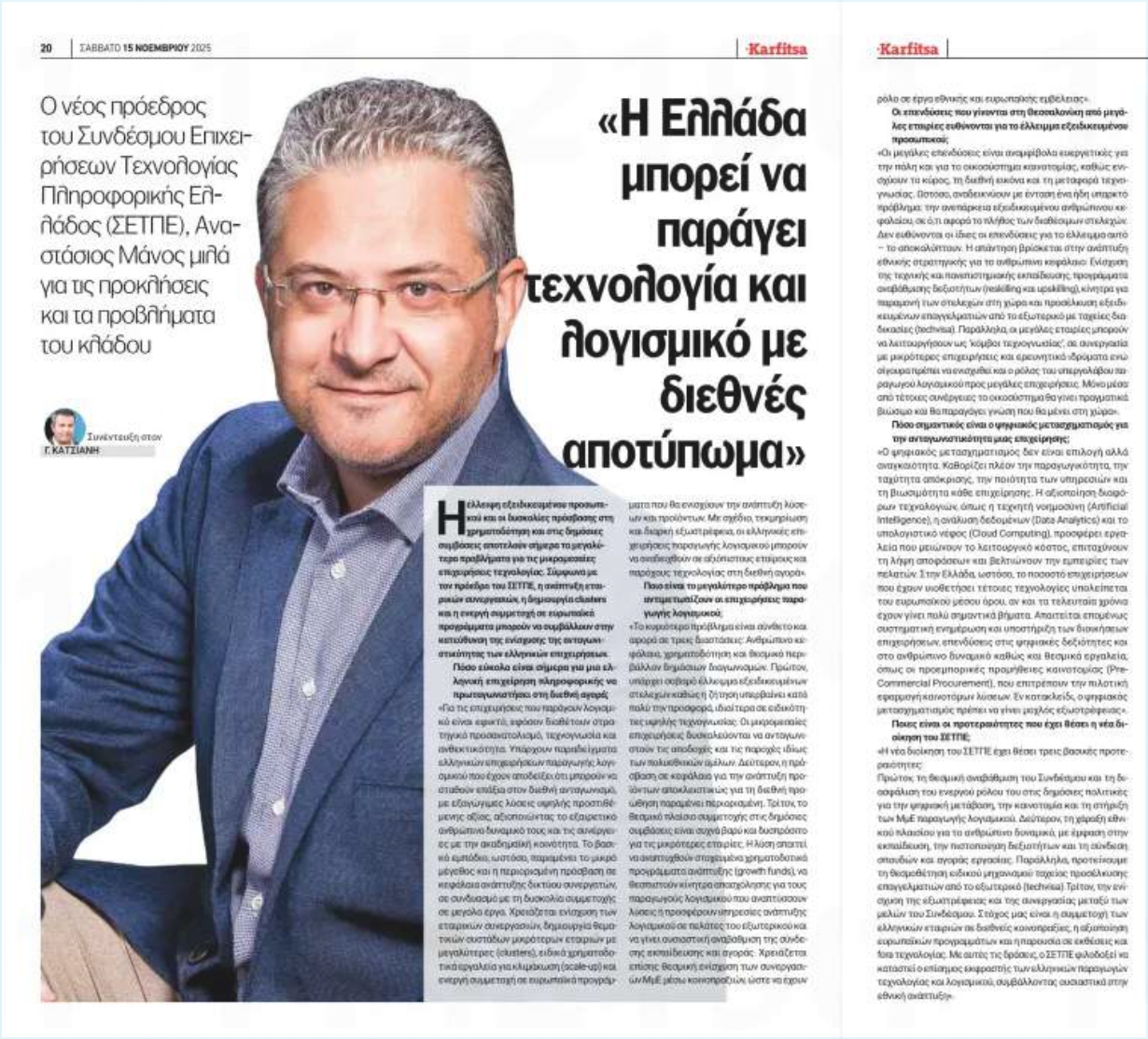
INTERVIEW | Anastasios Manos: “Greece Can Produce Technology and Software with an International Footprint”
Greece can produce technology and software with a global footprint, provided that new collaborations are fostered, the potential of IT professionals is fully utilised, and access to development capital is secured, emphasised the President of the Association of Hellenic Information Technology Enterprises (SETPE), Anastassios Manos, in an interview with the newspaper “Karfitsa.”
Speaking to journalist Giorgos Katsianis, Mr Manos referred to the shortage of specialised human resources, described the difficulties in securing funding, and outlined the institutional framework of public tenders, proposing a national strategy for digital skills along with targeted support measures.
He noted that digital transformation has now become a prerequisite for the competitiveness of Greek businesses, and outlined the three main priorities of SETPE’s leadership: strengthening the association’s institutional role, establishing a national framework for human resources, and enhancing the outward-looking orientation of its members.
In detail, Mr Manos’ interview is as follows:
- How easy is it today for a Greek IT company to take a leading position in the international market?
For software-producing companies, this is achievable, provided they have a clear strategic orientation, strong expertise, and resilience. There are Greek software firms that have demonstrated they can compete successfully on the international stage, offering high value-added solutions for export, drawing on their excellent human capital and their synergies with the academic community. The main obstacle, however, continues to be the small size of the companies and their limited access to capital for developing partner networks, combined with the difficulty of participating in large-scale projects. What is needed is stronger corporate collaboration, the creation of thematic clusters bringing smaller companies together with larger ones, dedicated financial tools for scaling up, and active participation in European programmes that support the development of solutions and products. With proper planning, solid documentation, and consistent outward-looking engagement, Greek software companies can establish themselves as reliable partners and technology providers in the international market.
- What is the biggest challenge faced by software-producing companies?
The main challenge is multifaceted and relates to three areas: human capital, financing, and the institutional framework of public tenders.
First, there is a significant shortage of specialised professionals, as demand far exceeds supply, particularly in high-expertise roles. Small and medium-sized enterprises struggle to compete with the salaries and benefits offered by multinational corporations.
Second, access to capital for product development aimed exclusively at international expansion remains limited.
Third, the regulatory framework for participating in public contracts is often cumbersome and difficult for smaller companies to navigate.
The solution requires the development of targeted growth funding programmes, the introduction of employment incentives for software producers who develop solutions or provide software development services to international clients, and a substantial upgrade of the link between education and the labour market. It also calls for institutional support to strengthen SME collaborations through consortia, enabling them to participate in projects of national and European significance.
- Could the investments made by major companies in Thessaloniki be contributing to the shortage of skilled personnel?
Major investments are undoubtedly beneficial for the city and its innovation ecosystem, as they enhance reputation, international profile, and knowledge transfer. However, they also sharply highlight an existing issue: the shortage of specialised human capital in terms of the number of available professionals.
The investments themselves are not responsible for this shortage—they merely reveal it. The solution lies in developing a national strategy for human capital: strengthening technical and university education, implementing reskilling and upskilling programmes, providing incentives for professionals to remain in the country, and attracting specialised talent from abroad through fast-track processes such as a tech visa. At the same time, large companies can act as “knowledge hubs” in collaboration with smaller enterprises and research institutions, while the role of software subcontractors for major businesses should also be reinforced. Only through such collaborations can the ecosystem become truly sustainable and generate knowledge that remains in the country.
- How important is digital transformation for a company’s competitiveness?
Digital transformation is not a choice but a necessity. It now determines the productivity, responsiveness, service quality, and sustainability of every company.
The adoption of various technologies, such as Artificial Intelligence (AI), Data Analytics, and Cloud Computing, provides tools that reduce operational costs, speed up decision-making, and enhance customer experiences. In Greece, however, the proportion of companies that have embraced these technologies remains below the European average, although significant progress has been made in recent years.
Systematic information and support for company management, investments in digital skills and human capital, as well as institutional tools—such as Pre-Commercial Procurement, which allows for the pilot implementation of innovative solutions—are therefore required.
In conclusion, digital transformation must become a driver of outward-looking growth.
- What are the priorities set by the new leadership of SETPE?
The new leadership of SETPE has set three main priorities:
First, the institutional enhancement of the Association and the assurance of its active role in public policies for digital transition, innovation, and the support of SMEs in software production.
Second, the development of a national framework for human resources, with a focus on education, skills certification, and the connection between studies and the labour market. At the same time, we propose the establishment of a dedicated mechanism for the rapid attraction of professionals from abroad (tech visa).
Third, strengthening the outward-looking orientation and collaboration among the Association’s members. Our aim is to enable Greek companies to participate in international consortia, make the most of European programmes, and have a presence at technology exhibitions and forums.
Through these initiatives, SETPE aims to become the official voice of Greek technology and software producers, making a meaningful contribution to national development.
See the interview with the Chairman of the BoD of SETPE, Mr Anastasios Manos, in the newspaper Karfitsa.
